
August 13, 2026
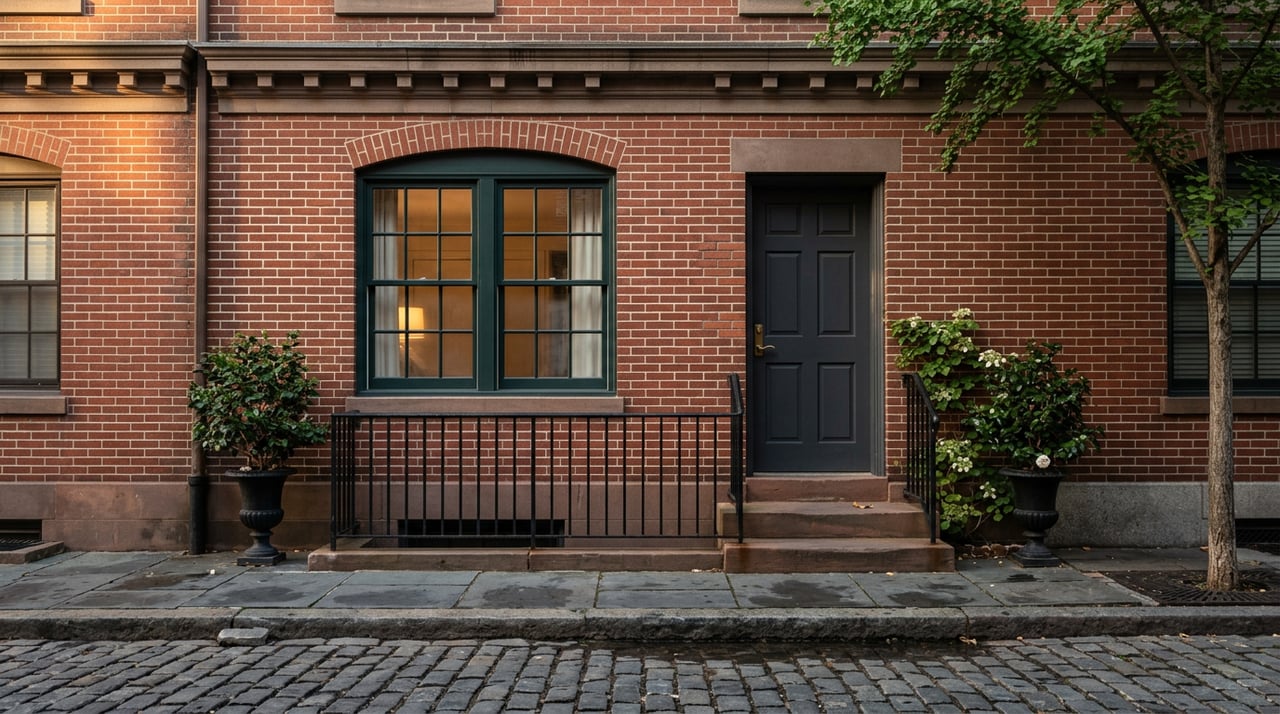
Walk the length of Bond Street on any weeknight this August and you'll pass a 1949 Off-Broadway theater, a whiskey distillery wedged into a manufacturing building raised in the late 1930s, a bar named after a man who held down the block for sixty years, and a restaurant that's been running the same slow-food menu since long before the newer arrivals showed up. Not one of these buildings looks new. Almost everything happening inside them is.
That consistency isn't an accident of taste. It's a rule.
Much of Bond Street sits inside the NoHo Historic District Extension, the designation that keeps the block's 19th-century facades intact even as what happens behind them turns over. The Gene Frankel Theater at 24 Bond Street is one of the buildings the extension protects, iron-and-brick facade included, right down to the small gilded figures known as the Golden Dancers that have decorated the front of the building since artist Bruce Williams installed them. The theater still runs a 74-seat house that Gene Frankel founded in 1949, staging plays within its old walls. That's the pattern that repeats up and down the block. New tenants don't get new architecture. They get old walls and whatever ambition fits inside them.
The most literal proof of that constraint sits a block off Bond Street, at 686 Broadway and Great Jones, where Great Jones Distilling Co. spent more than four years and over 6,000 floor plans figuring out how to fit a working whiskey distillery into a building that predates World War II, without touching its footprint. According to Gothamist's account of the build-out, the crew had to lower an entire floor by five feet to house the 500-gallon copper pot still and its two 28-foot columns, and construction crews coordinated with the MTA to lay pipe between passing subway trains, since the tracks run directly underneath. Midway through the renovation, workers found a sealed tunnel believed to have moved liquor under the street during Prohibition. It now runs behind the basement speakeasy, so the space that once helped hide whiskey from the law now serves it legally. When the distillery opened in 2021, it became Manhattan's first legal whiskey distillery in a hundred years.
As project manager Andrew Merinoff put it to Gothamist during construction:
"You never lose sight of the fact that we're in a manufacturing zone."
The distillery's whiskey is still aged upstate at Black Dirt Distillery in the Black Dirt region of Warwick Valley, since the Broadway building has no room for barrel aging. That round trip finally paid off in late 2025 with the release of the 10 Year Distillery Reserve Bourbon, hand-blended by head distiller Celina Perez in collaboration with Black Dirt founder Jason Grizzanti. It's the first bottling old enough to reflect the operation's full run, and you can only buy it at the Broadway location.
A block over, the same old-building logic produced a different kind of continuity. Jac's on Bond, the new watering hole from the team behind Pebble Bar, Ray's, and Georgia Room, recently opened inside a landmarked 1831 townhouse on Bond Street's cobblestones. Before Jac's, the space belonged to The Smile, an Authentic Hospitality cafe that spent years building a regular crowd on that same corner. Rather than erase that history, the new owners named the bar after Jack Champlin, the man noho.nyc describes as the "Mayor of Bond Street," a fixture of the block for more than sixty years. The building didn't change hands so much as it changed hats, and the new tenants chose to name their bar after the guy who'd been standing on that sidewalk since before most of the current stretch existed.
Not everything on Bond Street is reacting to a landmark rule. Some of it simply predates the current wave entirely and hasn't needed to change. Il Buco has been serving Bond Street the same way for years, an early adopter of the Slow Food approach at a time when that wasn't a marketing angle, and its sister project, Il Buco Alimentari & Vineria, still runs the block's closest thing to an Italian marketplace, bakery, and coffee bar in one room. A few doors down, Bond Street Theatre, a nonprofit that settled into a loft at 2 Bond Street back in 1976, still splits its time between running a Young Audiences Program for New York City schools and sending theater workshops into conflict zones from Afghanistan to Guatemala. Merchant's House Museum still opens its rooms for small private events. These institutions have their own histories alongside the newer arrivals. The block's constraints protect old tenants the same way they slow down new construction.
If you live here and want to explore Bond Street and its nearby destinations, one possible order is:
The itinerary reaches beyond Bond Street, taking in nearby destinations as well as the block itself.
The tension in all of this is that the businesses inside these old shells keep outgrowing them. BONDST, the sushi restaurant that's held its spot in a historic Bond Street brownstone for more than two decades, already expanded to a second location in Hudson Yards, and its own site now points to a Miami location opening in 2027 near Bal Harbour, a 17,000-square-foot build at One Kane in Bay Harbor Islands with a waterside terrace the original townhouse could never fit. Meanwhile, the stretch of Bond Street between Lafayette and the Bowery, which never had the Belgian block paving that survives between Broadway and Lafayette, is also home to 40 Bond, Ian Schrager's condo tower, which changed the street's massing the moment it went up. The historic district protects the shell. It doesn't guarantee the businesses inside it stay small, or stay put.
That's the actual shape of Bond Street right now. Two blocks where the buildings can't be torn down, filled with tenants old enough to have outlasted trends and new enough to be exporting their own name to other cities. The block hasn't changed its face in decades. What's inside it never stops moving.
If you're weighing what that kind of continuity is worth in a home purchase, whether in NoHo or one of the other downtown districts where landmark rules shape what a building can and can't become, Charlar Acar has spent years reading these blocks street by street. Get Access To Our Private Listings and find out what's actually available behind these old facades.
This article is general information, not legal, tax or financial advice. Consult a qualified professional about your situation.
Stay up to date on the latest real estate trends.
October 15, 2026

Market Update
Charlar Acar | October 10, 2026
Supply Is Still Tight. Buyers Are Discerning. Luxury Continues To Outperform
October 8, 2026
October 1, 2026
Market Update
Charlar Acar | September 25, 2026

Homebuyers
Charlar Acar | September 25, 2026
September 24, 2026
September 17, 2026

Lifestyle
Charlar Acar | September 10, 2026
For more than 6 years as an ABR, he has merited the trust of his clients and the respect of his colleagues in the real estate industry. He keeps confidences and represents each party with the highest level of service while bringing intelligence and skill to each transaction, large or small.