
September 3, 2026
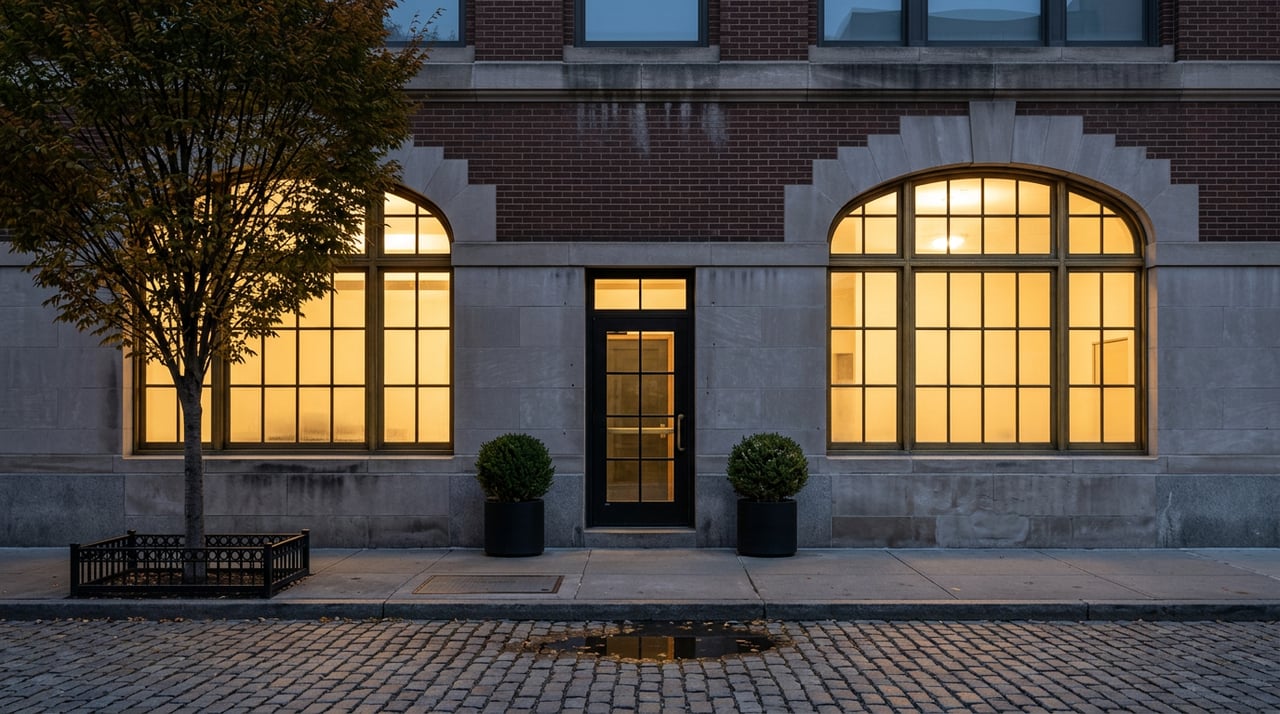
Walk south on Broad Street past the New York Stock Exchange and you will pass 25 Broad without much notice. It looks like what it was built to be in the early 1900s: a bank. The columns are still there. The proportions still say vault, still say ledger, still say do not touch. Then you find the narrow staircase tucked into the sidewalk, the one that leads down instead of up, and you learn that the building's original purpose has been quietly retired. What used to secure other people's money now serves cocktails.
That is not a metaphor stretched to fit a real estate blog. It is the literal layout of Bueno, the Latin-inspired restaurant and lounge that opened on the lower level of 25 Broad Street this past June, one floor below a Japanese restaurant called Yamasaki that took the ground floor the same day. The two spaces share a kitchen leadership, Culinary Director Steve Song, whose résumé runs through Masa, Bar Masa, and Jean-Georges Vongerichten's ABC Kitchen. But they share something more interesting than a chef: the building's original bank vault door still separates Bueno's lounge from its dining room, and the walls of that dining room are lined floor to ceiling with the brass safety deposit boxes that once held the neighborhood's valuables. Guests now sit in merlot-toned banquettes surrounded by them.
That detail is worth sitting with, because it says something true about Financial District life in 2026 that a generic neighborhood roundup will not tell you. FiDi has always run on two separate clocks. One belongs to the trading floor: opens at 9:30, closes at 4:00, empties out by 6:00, dead on weekends. The other clock belongs to everyone who actually lives between Battery Park and the Seaport, and for most of this neighborhood's modern history, that second clock had thin hands. This fall, for the first time in a while, it does not. The proof is not a press release. It is a bank vault with a bar built into it.
None of this is new to Stone Street. The cobblestone block a few minutes from 25 Broad has been running its own calendar since long before FiDi had one worth mentioning. Ulysses' Folk House was the first pub to open on the street back in 2003, and it has stayed a fixture through every wave of Wall Street change since. Two doors down, Antica Ristorante keeps the same warm, unhurried Italian dinner service it has offered for years. A short walk away, Fraunces Tavern has been serving food and drink in some form since 1762, survived a near demolition around 1900, and was restored under new ownership in 1907. It is the kind of place where you can still walk into the Long Room and feel like the ledger of the neighborhood's history is sitting open in front of you.
The contrast matters. Stone Street's businesses did not need an opening-day press cycle to prove they belonged here. They earned it one Tuesday happy hour at a time, over two decades. What 25 Broad is doing now, with its splashy dual launch and its repurposed vault, is compressing that same slow neighborhood trust-building into a single loud weekend. Both approaches are real. Neither one cancels the other out. That is the actual state of FiDi's food and drink scene heading into fall: an old guard that never had to advertise itself, sitting a few blocks from a new guard that is advertising itself very well.
The neighborhood's other fall arrival is quieter but still worth knowing before it shows up on your daily walk. UNIQLO is set to open a store this fall inside the World Trade Center at 185 Greenwich Street, joining the brand's existing Manhattan locations at Fifth Avenue, Bryant Park, Hudson Yards, Union Square, and a handful of others. It is not a headline event. But a national retailer choosing to plant a flag inside the WTC complex, rather than treating FiDi as strictly an office address, is one more small signal that the neighborhood's daytime population is no longer the only population anyone is building for.
If Stone Street and 25 Broad represent two different speeds of the same clock, the South Street Seaport is keeping time on an entirely separate one, and it barely intersects with the trading floor at all.
The Rooftop at Pier 17 launched what organizers are calling its biggest concert season yet this year, opening May 2 with MIKA and running more than 60 shows from spring through the fall, with acts ranging from Belle and Sebastian to Rise Against to Jimmy Eat World. That is a summer concert calendar operating on the same waterfront where hedge fund analysts eat lunch on weekdays, and the two rarely overlap.
Then, on September 26, the neighborhood's fall food event lands: Taste of the Seaport, hosted across Piers 16 and 17, brings together local restaurants and small businesses in a single afternoon that directly funds two area public schools, Peck Slip School and Spruce Street School. It is the kind of event that has nothing to do with commerce in the Wall Street sense and everything to do with the neighborhood functioning as an actual residential community with its own kids, its own schools, and its own reasons to gather.
After that, the Seaport pivots again. Winterland, the rooftop ice rink atop Pier 17, is the only open-air rooftop rink in the city and typically opens for the season in late November, running into March with a 5,400-square-foot rink, a skate shop, and a winter market built around it. Between the concert series, the food festival, and the ice rink, the Seaport runs three distinct seasonal identities in a single calendar year, and none of them wait for the market to close early or open late. They simply happen, on their own schedule, regardless of what the Dow did that day.
Not everything new in FiDi is loud, and the neighborhood's best-kept counterexample has been sitting in plain sight for years without needing a single press release. The Elevated Acre, a one-acre green space perched above street level at 55 Water Street, is reached by an outdoor escalator tucked behind the building, easy to walk past if you do not already know it is there. It is free, it looks out over the East River toward Brooklyn and the Brooklyn Bridge, and it remains one of the few spots downtown where the density of the neighborhood actually falls away for a few minutes. It asks nothing of you. No reservation, no ticket, no dress code. It is worth remembering that FiDi's loudest fall news this year is happening a few blocks from a park most of the neighborhood still has not found.
If you already live here, the practical version of all this looks less like a list of openings and more like a loop you can walk in a single Saturday.
None of this requires you to think about property values or comparable sales. That is not what this fall is about. What it does require is paying attention to a neighborhood that is quietly running two calendars at once, the trading floor's and everyone else's, and noticing that the second one finally has enough on it to fill a weekend.
If you are watching this neighborhood for reasons beyond a Saturday loop, that same density of new activity, from a historic bank building finding a second life to a park most people still cannot locate, tends to matter later, when you are trying to understand what a building or a block is actually worth to the people who live near it. Charlar Acar tracks that shift building by building across Lower Manhattan, and if you want a conversation about what it means for a specific address here, reach out any time.
Stay up to date on the latest real estate trends.
Market Update
Charlar Acar | September 25, 2026

Homebuyers
Charlar Acar | September 25, 2026
September 24, 2026
September 17, 2026

Lifestyle
Charlar Acar | September 10, 2026
September 3, 2026

Luxury Real Estate
Charlar Acar | August 27, 2026
August 27, 2026
Lifestyle
Charlar Acar | August 13, 2026
For more than 6 years as an ABR, he has merited the trust of his clients and the respect of his colleagues in the real estate industry. He keeps confidences and represents each party with the highest level of service while bringing intelligence and skill to each transaction, large or small.