
Charlar Acar | July 2, 2026
Lifestyle
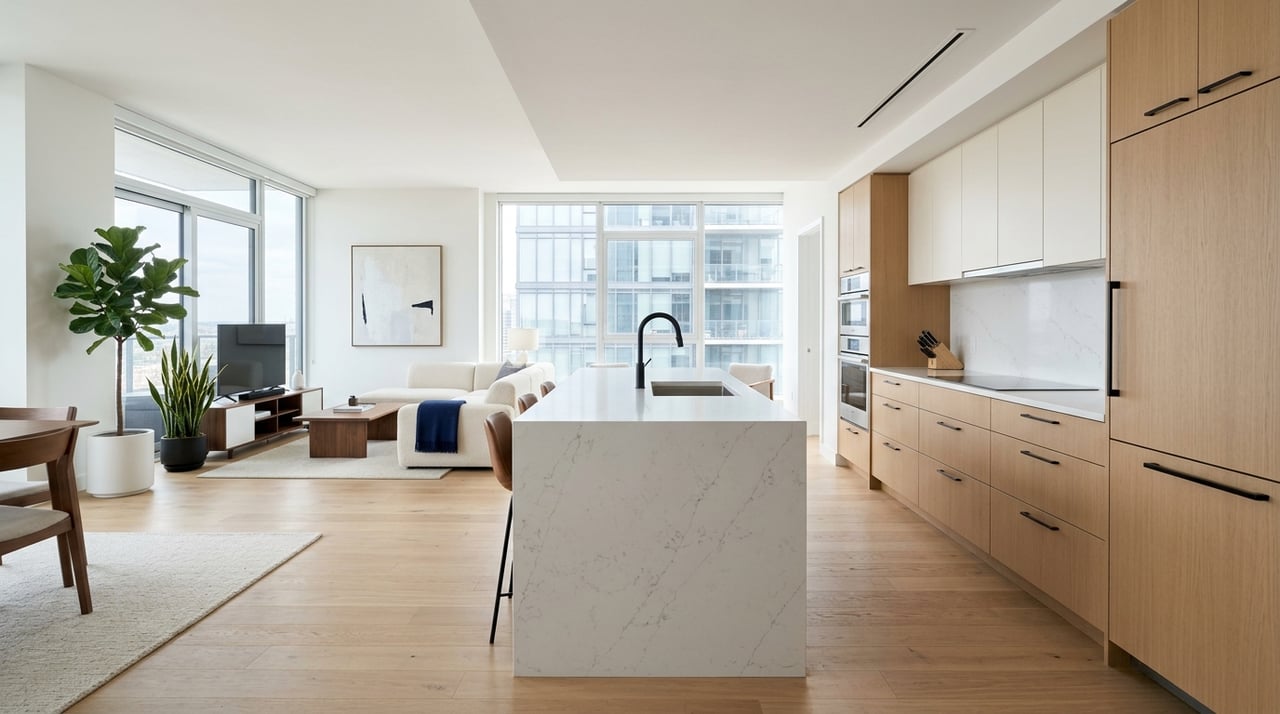
If you are looking at Hudson Yards condos, you are not just shopping for square footage. You are weighing a very specific kind of Manhattan lifestyle, one built around service, convenience, and a highly managed residential experience. Understanding that difference can help you decide whether Hudson Yards is the right fit for how you live, entertain, and budget. Let’s dive in.
Hudson Yards is a 28-acre master-planned development on Manhattan’s West Side that opened to the public in March 2019. It was built as a mixed-use district with roughly 18 million square feet, more than 100 shops and restaurants, 14 acres of public open space, and about 4,000 residences.
For condo buyers, that matters because the residential towers were designed as part of a larger campus. Instead of a traditional Manhattan neighborhood pattern with many smaller buildings, Hudson Yards offers a more concentrated set of large, service-heavy towers tied to retail, hospitality, office, and cultural uses.
In the core development, the main for-sale condominium buildings are 15 Hudson Yards and 35 Hudson Yards. Fifteen Hudson Yards was the first residential building to open and has 285 for-sale homes, while 35 Hudson Yards has 143 for-sale residences and is the tallest residential building in the district.
In Hudson Yards, “amenity-first” living goes far beyond a fitness room and roof deck. The model is built around hotel-style services, wellness programming, dining access, private entertaining space, and concierge support that can reduce how much of daily life you need to manage on your own.
For the right buyer, that is the appeal. You are not simply buying an apartment. You are buying into an internal lifestyle system designed to support work, leisure, guests, wellness, and convenience in one place.
15 Hudson Yards organizes a large part of its resident experience around dedicated upper-floor amenity spaces. The 50th floor is focused on wellness, while the 51st floor is centered on entertainment, leisure, and work functions, with a skytop entertaining suite above.
The wellness spaces include a 75-foot pool, spa treatment rooms, a fitness center, a yoga and group class studio, and a children’s imagination center. The entertainment and work areas include a club room, private dining suites, a screening and performance room, a golf club lounge, wine storage and tasting, a business center, and collaborative workspace.
On the service side, 15 Hudson Yards advertises 24-hour support that includes pre-arrival provisioning, grocery shopping and refrigerator stocking, housekeeping, pet care, plant care, 24-hour in-residence dining, personal assistance, butler service, florist service, catering, transportation assistance, business support, and translation services.
That service menu makes the building especially appealing if you want a lock-and-leave lifestyle or frequent support for guests and day-to-day logistics. It also has a 24/7 concierge-attended lobby, an on-site parking garage, valet service, and pet-friendly services.
35 Hudson Yards leans even more directly into a hotel-adjacent lifestyle. The building includes 22,000 square feet of private residential amenities, along with access to a 60,000-square-foot Equinox Fitness Club and spa and service connections through the Equinox Hotel next door.
Residents also have direct elevator access to on-site dining concepts and can receive preferred reservations, catering, and in-residence dining. In practical terms, that creates a very seamless experience for buyers who value on-demand convenience and hospitality-driven service.
The residential amenity program includes a lounge and bar overlooking Vessel, a billiards lounge, a golf simulator lounge, a private dining room for sixteen, a library, a screening room, a children’s playroom, a board room, private office space, and a 24th-floor Grand Terrace and Grand Dining Room for larger events.
While both buildings are luxury condos within the same district, they do not feel identical. The differences in layouts, finishes, and overall scale can shape which building feels more natural for your routine and priorities.
15 Hudson Yards offers five residence types across one- to four-bedroom homes. These include Plaza Residences, Loft Residences, Panorama Residences, penthouses, and Duplex Upper Penthouses.
That variety gives buyers a wider range of formats. Recent floorplan snapshots show two-bedroom homes around 1,777 square feet, four-bedroom homes around 3,058 to 3,128 square feet, and a four-bedroom duplex penthouse at 5,139 square feet.
The finishes are contemporary and polished. Features include wide-plank white oak flooring, Miele kitchen appliances, two interior design palettes, filtered fresh air, Lutron home automation, and a grey-water recycling system used for cooling and irrigation.
35 Hudson Yards is more boutique in scale and more vertical in character. Homes begin on the 53rd floor, range from two to six bedrooms, and run from about 1,500 to 10,000 square feet.
The layouts are oriented toward larger-format, high-floor living. The building features gracious foyers and galleries, ceilings rising to nearly 11 feet, and expansive glass, which creates a more formal and private residential feel.
Its interiors also read differently from 15 Hudson Yards. Kitchens are conceived as separate rooms with tall wood doors connecting to breakfast rooms, family rooms, or dining rooms, and the material palette includes Gaggenau appliances, Smallbone of Devizes cabinetry, smoked oak floors, and Taj Mahal white quartzite.
Bathrooms emphasize extensive stonework, including Iceberg Quartzite, Dolomiti marble, grey onyx, and Polaris Quartzite. In broad terms, 35 Hudson Yards tends to suit buyers who prefer a more room-driven layout and a more traditional approach to formal entertaining.
If you are choosing between these buildings, it helps to focus on how you actually plan to live rather than only comparing finishes or asking prices. In Hudson Yards, the service model and amenity package are a major part of the ownership experience.
Here are a few practical questions to ask:
In amenity-heavy buildings, monthly carrying costs deserve close attention. Even if the residence itself fits your needs, the ongoing cost structure should match your comfort level and long-term plans.
In New York City, condo owners receive property tax bills from the Department of Finance either quarterly or semiannually. For tax year 2026, the official Class 2 property tax rate is 12.439%, and Hudson Yards condos fall into Class 2, so the tax bill depends on assessed value, exemptions, and whether the unit qualifies for any abatement.
Eligible condominium owners may receive the city’s co-op and condo tax abatement only if the building applies for it and the unit is the owner’s primary residence. The board or managing agent handles the filing, not the individual owner, and the annual filing deadline is February 15.
Current listing snapshots show how much monthly costs can vary. At 15 Hudson Yards, recent listings showed common charges from about $4,320 to $17,730 per month, with monthly taxes shown from $45 to $182. At 35 Hudson Yards, recent listings showed common charges from about $4,529 to $14,499 per month, with monthly taxes from $301 to $849.
These are unit-specific snapshots, not building-wide averages. Still, they highlight an important point: in Hudson Yards, common charges can be a major part of ownership costs before you even factor in financing.
Hudson Yards often works best for buyers who want convenience built into the building itself. If you value concierge support, structured amenities, dining access, wellness facilities, and a campus-style environment, the neighborhood’s model may feel highly efficient and appealing.
It can also be a strong fit if you spend time between cities, host frequently, or want a more managed ownership experience. The service infrastructure in these buildings supports a lifestyle that is easy to lock, leave, and return to.
On the other hand, if you prefer a more traditional Manhattan condo experience with lower reliance on building services, Hudson Yards may feel less personal and more operational. That is why the right match usually comes down to lifestyle fit as much as the apartment itself.
For buyers considering this part of Manhattan, a building-level review is essential. The most successful search is usually not “Hudson Yards vs. everywhere else,” but rather “which Hudson Yards building, line, exposure, and service model best supports the way you live.”
If you want a discreet, evidence-driven look at Hudson Yards condos, including how specific units compare on layout, carrying costs, and long-term fit, Charlar Acar can help you evaluate the options with the level of detail these buildings deserve.
Stay up to date on the latest real estate trends.
October 15, 2026

Market Update
Charlar Acar | October 10, 2026
Supply Is Still Tight. Buyers Are Discerning. Luxury Continues To Outperform
October 8, 2026
October 1, 2026

Market Update
Charlar Acar | September 25, 2026

Homebuyers
Charlar Acar | September 25, 2026
September 24, 2026
September 17, 2026

Lifestyle
Charlar Acar | September 10, 2026
For more than 6 years as an ABR, he has merited the trust of his clients and the respect of his colleagues in the real estate industry. He keeps confidences and represents each party with the highest level of service while bringing intelligence and skill to each transaction, large or small.